Egyptian Astrology
The history and contributions of Egyptian astrology to the current field of astrology remain relatively unknown to the Westernized world. “Egyptian Astrology” is referred as “Hellenistic astrology”. It’s a tradition of horoscopic astrology that was developed and practiced in the late Hellenistic period especially in Egypt. The texts and technical terminology of this tradition of astrology were largely written in Greek. The tradition originated sometime around the late 2nd or early 1st century BCE and then was practiced until the 6th or 7th century CE. This type of astrology is commonly referred to as "Hellenistic astrology" because it was developed in the late Hellenistic period, although it continued to be practiced for several centuries after the end of what historians usually classify as the Hellenistic era.
We now know that about a year has over 365 days. To be a little more exact, the value is 365.2421896698. The very old Egyptians were remarkably close to this figure almost 5000 years ago. They also developed the 24 hour time frame roughly around the same period. Another mind-blowing discovery revealed that the ancient Egyptians had star charts that date as far back as 4200 BC.
Their version of astrology was short and simple. The predictions with the pole star proves this point. Predicts would carefully note down the appearing time and disappearing time of the pole star. They then became aware of that whenever the Nile flooded, the star rose before the sun and stood closer it. This gave the people a head start on the precautionary measures that needed to be taken, if necessary.
If the conjunction happens at a particular star sign, twenty years from now, it will happen at the star located 120a° from it (Aries>Cancer>Libra>Capricorn and so on. This phenomenon is called “Triplicity”. Each triplicity is ruled by four elements that is, Water, Fire, Wind, and Earth. The effects of this visible sign will depend on the element that strongly expresses rule over where the conjunction falls.
Several Hellenistic astrologers ascribe its creation to a mythical sage named “Hermes Trismegistus”. Hermes is said to have written several major texts which formed the basis of the art or its evolution from the system of astrology that was inherited from the Babylonians and the Egyptians. Several authors cite Hermes as being the first to outline the houses and their meaning, and thus the houses are usually thought to date back to the very beginning of the Hellenistic tradition and indeed they are one of the major defining factors which separate Hellenistic astrology and other forms of horoscopic astrology from Babylonian astrology and other traditions in different parts of the world. This system of horoscopic astrology was then passed to another mythical figure named “Asclepius” to who some of the Hermetic writings are addressed.
Most of our understanding of Egyptian astrology is contained within the Cairo Calendar, which consists of a listing of all the days of an Egyptian year.
The listings within the calendar all take the same form and can be broken up into three parts:
- the type of day (favourable, unfavourable. etc)
- a mythological event which may make a particular day more favourable or unfavourable
- a prescribed behaviour associated with that day.
Unlike modern astrology as found within newspapers, where one can choose whether to follow the advice there in or not, the Egyptians strictly adhered to what an astrologer would advise. As is evidenced by the papyrus of the Cairo Calendar, on days where there were adverse or favourable conditions, if the astrologers told a person not to go outside, not to bathe, or to eat fish on a particular day, such advice was taken very literally and seriously.
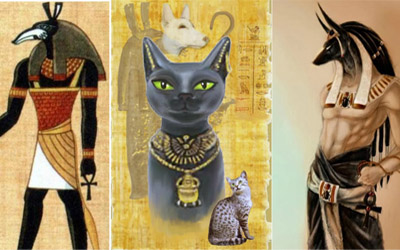
Some of the most interesting and misunderstood information about the Ancient Egyptians concerns their calendrical and astrological system. Of the greatest fallacy about Ancient Egypt and its belief in astrology concerns the supposed worship of animals.
Egypt today has its own form of astrology that largely resembles the Greco/Roman classical form. There are websites and astrologers that use an individual's birth date to determine which Egyptian god exercises authority and influence over a person's psyche. In many cases, the subject's astrological profile closely parallels his western natal reading, which is not too much of a surprise.
The first astrologers were a group of baru-priests who resided in Egypt and acted as advisors for kings and important individuals. It was common for people during this time to worship the planetary entities of the sky, such as the sun, moon and any recognizable planets at that time -- notably Venus. These planets were considered to be influenced by the gods or thought to be gods themselves, and the baru-priests would read the skies frequently to determine the outcome of future events. Hence, Egypt was no different from other cultures who employed predictive astrology as a way of unveiling the mysteries of the universe.
The Role of Ptolemy
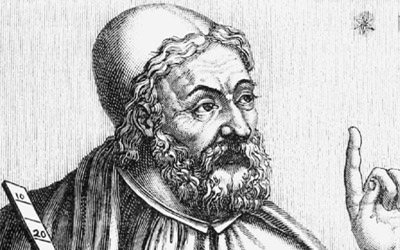
The Egyptian system of astrology was nowhere near as complex as modern day astrology because it had not yet developed to such a point. The influence of foreign invaders and surrounding cultures, along with certain newfound astronomical precepts, would help advance Egyptian astrology into something far more elaborate. One of the most integral contributors to the cause was an Alexandrian mathematician named “Claudius Ptolemy”. By the time Ptolemy entered the scene, Egyptian culture had already been heavily influenced by the Hellenistic Greeks and, later, Roman occupation.
Ptolemy is famous for several works, the most influential amongst them being his “Tetrabiblos”, a four volume work that assessed and relayed his astronomical and astrological research and opinions. Ptolemy identified many stars and constellations in his day, but his astrological work is notable more in his listing of the various influences specific planetary alignments had over events, people and such. It is from this work that the aspects and angles of modern astrology draw their origin. Ptolemy also postulated ideas such as the planets themselves being responsible for certain energies and effects over countries and individuals. His work is heavily theoretical, but it is easy to see how his ideas have morphed, but continue to play out, in Western astrology.
Unfortunately, Ptolemy supported the idea that the universe revolved around the planet earth. This false hypothesis was damaging enough to the field of astronomy, and it took numerous centuries for the scientific community to rectify such assertions. Still, Ptolemy's work in Alexandria has been foundation for astrologers, even today.
Modern Egyptian Astrology
The average American can experiment with the simplest ideas of Egyptian astrology today over the Internet, where many sites will identify an individual's ruling Egyptian god by entering their date of birth into a database. The simple forms of Egyptian astrology match certain dates to an Egyptian god and display how this god's nature affects an individual's psyche. Unlike Western astrology that has the periods of the zodiacal influence divided over twelve approximately month-long period of time, the divisions of time in Egyptian astrology can have three or four governing entities within a single month.